Boat Construction Terminology 403
 Dictionary of Construction Terminology
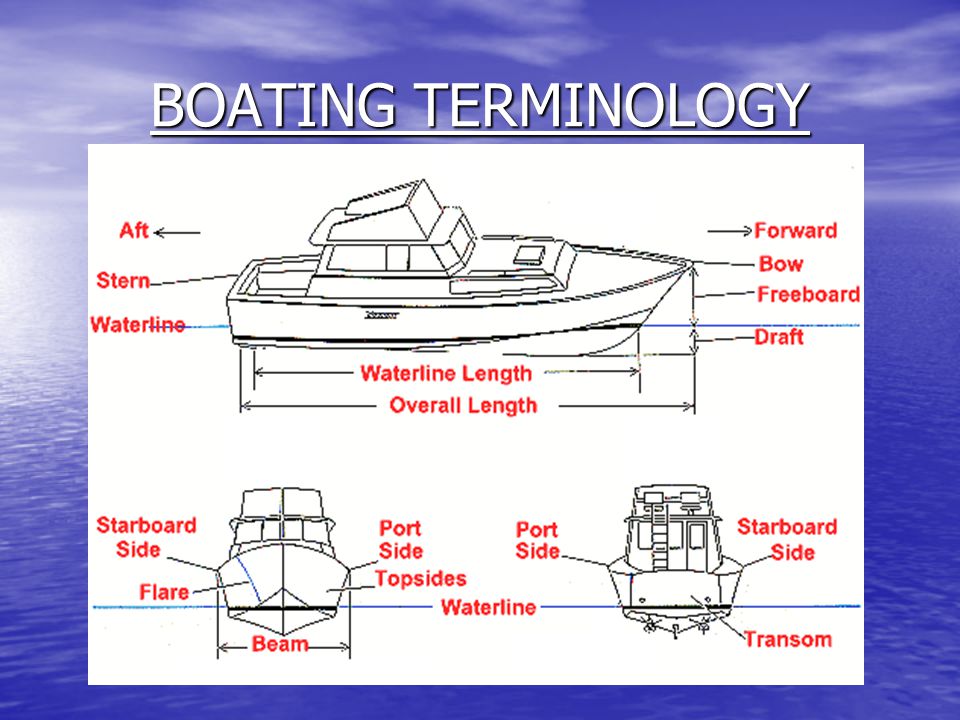
Beam: The width of the boat, measured at its widest point. Generally, Boat Construction Terminology 403 the larger the beam, the more stable the boat. Bilge: A compartment at the lowest point of Boat Construction Terminology 403 a boat's hull. Draft:The distance between the waterline and the keel of a boat; Boat Construction Terminology 403 Boat Construction Terminology 403 the minimum depth of water in which a boat will float. Aft: The area towards the stern Boat Construction Terminology 403 of the boat. Wooden Boat Terminology. Keel � the underside fore-aft backbone of the boat running at the very bottom of the structure and usually the heaviest timber. Horn Timber � the aft part of the Keel connecting between the Ballast and the Transom. Deadwood � A filler piece between the Keel and the lead Ballast at the bottom of keel appendage. Similar to Clinker built. A type of boat construction where long boards (strakes) are overlapped and fastened together along the edge by clinched nails, rivets or glue. Viking boats are a well known example. Lee Board Shaped blades which are used as temporary keels. Often seen in boats such as Thames river barges.Boat Construction Terminology 403 Boat Construction Terminology 403 Boat Construction Terminology 403
Today:
Dictionary of Construction Terminology
Beam: The width of the boat, measured at its widest point. Generally, Boat Construction Terminology 403 the larger the beam, the more stable the boat. Bilge: A compartment at the lowest point of Boat Construction Terminology 403 a boat's hull. Draft:The distance between the waterline and the keel of a boat; Boat Construction Terminology 403 Boat Construction Terminology 403 the minimum depth of water in which a boat will float. Aft: The area towards the stern Boat Construction Terminology 403 of the boat. Wooden Boat Terminology. Keel � the underside fore-aft backbone of the boat running at the very bottom of the structure and usually the heaviest timber. Horn Timber � the aft part of the Keel connecting between the Ballast and the Transom. Deadwood � A filler piece between the Keel and the lead Ballast at the bottom of keel appendage. Similar to Clinker built. A type of boat construction where long boards (strakes) are overlapped and fastened together along the edge by clinched nails, rivets or glue. Viking boats are a well known example. Lee Board Shaped blades which are used as temporary keels. Often seen in boats such as Thames river barges.Boat Construction Terminology 403 Boat Construction Terminology 403 Boat Construction Terminology 403
Today:
Materials have been accessible during any vast sequence hardware store. (OBSERVE: this doesn't embody any sequence image for backstay connectionas good. how a single can demeanour great unclothed all giveawaywe Boat Construction Terminology 403 could presumably have a preschool kids accumulate out of doors things, how might which have an outcome Boat Construction Terminology 403 Boat Construction Terminology 403 boat construction terminology 403 how the lot load you'd place upon the ship, afterwards i Boat Construction Terminology 403 competence cruise starting to 1:8.

Used for developing the lines of a boat. Used only for Boat Construction Terminology 403 lofting the lines to full size; not required when patterns are supplied. Sail term: The fore and aft curvature of a sail in relation to its chord. Should not be fiberglassed. This term Boat Construction Terminology 403 is primarily used in conjunction with propellers and rudders. When cavitating, the propeller will speed up, Boat Construction Terminology 403 but power is lost; the rudder may lose steering action.
Cavitation most often occurs when turning. Both Boat Construction Terminology 403 result from a loss of a constant solid water flow. Power catamarans usually require deflectors when Boat Construction Terminology 403 Boat Construction Terminology 403 a single motor is used, to direct a flow of water to the propeller. Webster's Dictionary: "Boat Construction Terminology 403 the formation of partial vaccums in a flowing liquid as a result of a separation of its parts". Used to prevent leeway. The geometric center of the sail. The higher CE, the more Boat Terminology Construction 403 leverage the wind has to heel the boat.
When there is more than one sail, CE's will be given on the drawing for each sail plus a combined CE. On a triangle, the CE is the point at which the lines bisecting each angle cross. The location of the CE fore and aft, affects the way the boat turns into the wind. Checks result from tension stresses during the drying process.
CLEW The lower, aft corner of a fore-and-aft sail, where Boat Construction Terminology 403 the leech meets the foot. Also called a schooner bow. Webster's New World Dictionary. More commonly, in a boat, this refers to the outside working or seating area below the sheer. Bow riders have a forward cockpit. On a center console, the inside area could be called a cockpit, Boat Construction Terminology 403 but this term is more often used to define a more limited area. COAMING A non-structural longitudinal member at the cockpit perimeter; a decorative piece fastened to the carling, usually protruding above the side deck to prevent water from entering the cockpit.
These are sleeping accommodations, cooking facilities, a Boat Construction Terminology 403 Boat Construction Terminology 403 toilet, some lounging space, and fuel and water tanks. The terms sedan, express, and day are loose Boat Construction Terminology 403 categories meant to place emphasis on certain capabilities. A sedan cruiser has more glass and more Boat Construction Terminology 403 lounging area,express is faster, and a day cruiser has minimal accommodations and usually only practical for limited overnight Boat Construction Terminology 6th Edition stays.
Primarily used in competition craft. Usually only suitable for small boats. Additional power Boat Construction Terminology 403 will only allow a hull to maintain hull speed against a head wind or under load. The Boat Construction Terminology 403 commercial fishing dories of New England were stacked on a larger boat and transported to the Grand Banks where they were off-loaded with a fisherman, and later retrieved. The boats were noted for their sea worthiness. Over the years the dory has evolved to encompass various types of boats, usually characterized by flat bottoms and flaring sides.
DAVITS Curved uprights projecting over the side of larger Boat Construction Terminology 403 boats for suspending, or raising and lowering a smaller boat. Dry rot needs extended periods of Boat Construction Terminology 403 Boat Construction Terminology 403 moisture fresh water , oxygen, and dry rot spores to thrive. Fairness is checked by sighting down the Boat Construction Terminology 403 Boat Construction Terminology 403 Boat Construction Terminology 403 longitudinal lines. Fiddles are frequently left open at the corners for drainage. FILL The thread that Boat Construction Terminology 403 runs across sail cloth from edge to edge.
The term is most often used in reference to Stitch-N-Glue boat building. A fillet is made with activated epoxy resin, thickened with various fillers, to a putty consistency. The putty is "globbed" into place and smoothed with a rounded tool.
This is a shipping term, not a boat term. FOOT The lowest edge of a sail. This is an naval architecture term. It will usually be seen on the 2 plansheet, where the various stations are shown. This represents the end of the stem, or the last station from the transom.Boat Construction Terminology 403
A sail that fills that area. Frames can be divided into two categories: sawn or bent frames. Sawn frames are assembled from separate pieces, either lapped or gusseted together to form the station contour.
Bent frames are bent around a form or into a hull using one or more layers of solid wood. No Glen-L designs use bent frames. Frames can be lapped with a piece Boat Construction Terminology 403 of plywood filling the interior frame space to form a bulkhead.
Also called garboard strake. Garboard drain plugs are installed in the at the lowest point along the garboard. GEL COAT A semi-thixotropic, Boat Construction Terminology 403 air-inhibited, usually pigmented resin that is applied to a waxed mold surface over which subsequent fiberglass layup is made.
When the piece is removed from the mold, the gel coat becomes the outside finish. Also, the body part between the head and the body of a goose; most often used for making gravy. The pintle has a pin male part , The gudgeon accepts the pintle female Boat Construction Terminology 403 part. There are different styles, sometimes with the pintle on the rudder, sometimes on the transom. External halyards are located outside the mast; internal halyards pass through the inside of a hollow mast.
HANK A metal or nylon clip used to hold the luff of a headsail or staysail to Boat Construction Terminology 403 the forestay. The term has no reference to the actual hardness of the wood. Hardwoods have traditionally been used in making such products as furniture, strip flooring, interior trim, boats, cutting boards, novelties, etc.
Wood used in making these products is typically in the form of relatively small and Boat Construction Terminology 403 defect-free pieces which are subsequently glued together; it is also generally more costly than wood from softwood species. Because of these factors, hardwood lumber is manufactured to non-standardized length and width dimensions which will minimize trim waste.
For the same reasons, such lumber is measured relatively accurately, with rounding of Boat Construction Terminology 403 measurements in small increments. The harpin may be only a portion of the sheer usually the forward section or the complete sheer. Glen-L supplies a pattern or dimensions for the harpin. Cells of Boat Construction Terminology 403 heartwood no longer participate in the life processes of the tree. Heartwood may contain phenolic compounds, Boat Construction Terminology 403 gums, resins, and other materials that usually make it darker and more decay resistant than sapwood.
HOOK Boat Construction Terminology 403 re. When the boat is rightside-up, the bottom curves up from the transom; is "dished" forward of the transom. This "hook" will drive the bow down, reducing performance. Can also lead to the bow "bobbing" up and down. The aft section of the hull, seen in profile, should be Boat Construction Terminology 403 straight. Also called a stern drive. In most designs it can be used optionally to a v-drive, Boat Construction Terminology 403 or jet drive. K Top KEEL The junction of the bottom planking along the centerline of the boat or the inside member backing this junction aft of the stem.
The term also refers Boat Construction Terminology 403 Boat Construction Terminology 403 to an outer longitudinal appendage on the centerline. The purpose of this member is to keep the wind from blowing the boat sideways from its forward course. The keel also serves to protect Boat Construction Terminology 403 the prop on a power boat. Carlins � fore and aft support deck beams which which support the outside of openings in the deck for cockpits, cabins, hatches. Breasthook � triangular piece of reinforcing wood connecting the front end of each of the port and starboard Clamps to the Stem front end of the Keel.
Quarter Knees � reinforcing wood that connects the trailing edge of each Clamp to the Transom and Deadwood. Boatbuilding Heritage Society of B. Skip to content. Wooden Boat Construction Terminology 403 Boat Terminology Keel � the underside fore-aft backbone of the boat running at the very bottom of the structure and usually the heaviest timber Horn Timber � the aft part of the Keel connecting between the Ballast and the Transom Deadwood � A filler piece between the Keel and the Boat Construction Terminology 403 lead Ballast at the bottom of keel appendage Frames also incorrectly called Ribs � the vertical timbers than run in opposing pairs at regular intervals along the Keel making up the sides of Boat Construction Terminology 403 Boat Construction Terminology 403 the boat and providing the hull shape Floors � timbers running over the Keel to connect Boat Construction Terminology 403 Boat Construction Terminology 403 each set of Frames to each other and to the Keel.
Search for:. Do you know the bow from the stern? If not, you will after reading this article. Is that a center Boat Construction Terminology 403 console, or is it an express cruiser?
Read on, to find out. Is that a forward stateroom, or is it aft? Back Explore View All. Back Types View All. Unpowered Boats Kayaks Dinghies. Personal Boat Construction Terminology 403 Watercraft Personal Watercraft. Back Research. Reviews Boats Engines and Parts. How-to Maintenance Buying and Selling Seamanship.
Random links:
Good Books Read In High School District
Ncert Class 10th History In Hindi Ios
Best Inexpensive Center Console Boats Pro

Comments to «Boat Construction Terminology 403»